Capitol View Corridors: Which Austin Views Are Protected
What Austin's Capitol View Corridors protect, how new towers block unprotected views, and what to ask before paying a view premium.
By the Austin High Rise Apartment Team · · 5 min read

Why some Austin views are permanent
We regularly see clients pay top dollar for a downtown skyline view, only to lose it a year later to a new construction project. The real dividing line between a temporary vista and a permanent one comes down to specific zoning laws.
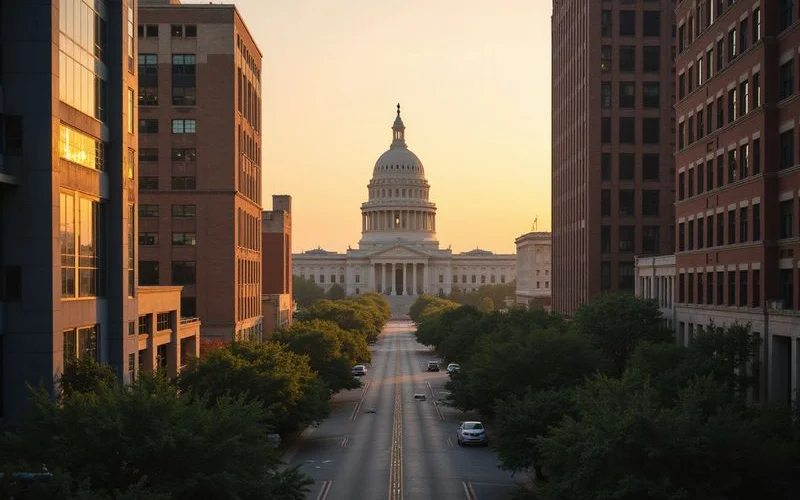
Austin protects sightlines to the Texas State Capitol through 30 designated Capitol View Corridors.
Our team tracks these three-dimensional invisible planes radiating from various points around the city toward the 311-foot Capitol dome. If a property sits within one of these paths, strict elevation caps prevent any new development from blocking the view. That specific height restriction is exactly why you will sometimes spot a three-story building squeezed tightly between 50-story high-rises.
We always tell renters looking to invest in premium high-rise units with the best views that understanding these sightlines is the only way to guarantee a lasting panorama. Let us review the current 2026 zoning data, what these regulations actually cover, and how to verify a unit before signing a lease.
What corridors protect, and what they don’t
These corridors legally protect specific public sightlines to the Texas State Capitol, but they do not guarantee private views of the lake or the broader skyline. The protection is an elevation ceiling, meaning the law only stops a building from piercing that specific diagonal plane.
We frequently remind clients that a lake or skyline view is only as permanent as the empty lot in front of it.
| View | Protected? |
|---|---|
| Sightline toward the Capitol dome within a corridor | Yes |
| A Capitol view outside any corridor | No |
| Lady Bird Lake views | No |
| General skyline views | No |
| Hill Country sunset views | No |
The 2001 recodification of the Texas Government Code Chapter 3151 strictly protects the 311-foot Capitol dome. It does not protect your condo’s line of sight to the Colorado River.
Our local analysts use the City of Austin’s zoning map to verify exactly where these three-dimensional planes intersect with specific parcels. This means a corridor can shape the skyline without protecting the entire view from a private residence. If your unit relies on a gap between buildings that falls outside the official overlay, that gap will likely close.
How unprotected views get blocked
Unprotected views disappear because Downtown Austin is constantly absorbing new supply. According to recent 2026 data from Matthews Real Estate, the pipeline of units under construction has contracted to 4.55% of inventory.
We often point out that a new 50-story tower can still rise on a parking lot or low-rise building in front of your stack and cut a view in just a couple of years.
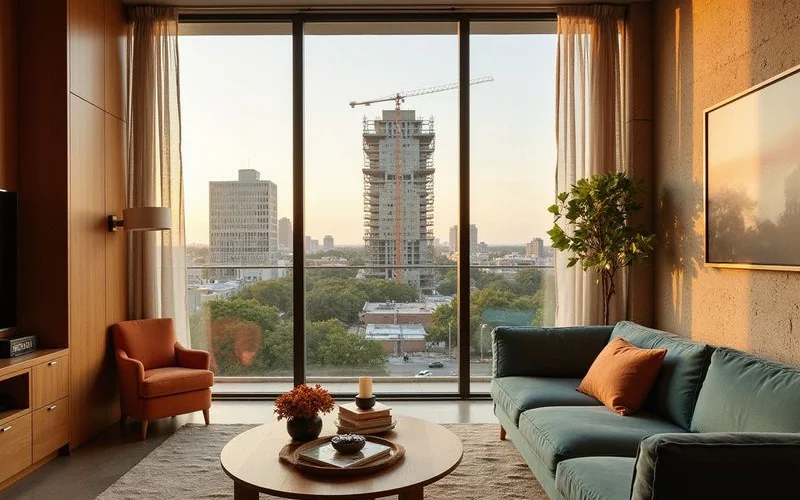
The parking lot test Look at what sits directly in front of your window. A surface parking lot or one-story building downtown is a highly probable future tower site.
Our local experts point to a specific example at the corner of Trinity and East 8th Streets. A surface lot there sits inside a corridor and is restricted to roughly three stories by the elevation cap. Just outside that invisible boundary, zoning allows developers to build massive skyscrapers like the 58-story Independent tower.
We recommend checking the City of Austin’s combining district overlay before assuming that an empty block will stay empty. You must assume any unprotected low-rise neighbor will eventually be redeveloped.
Questions to ask before you pay a view premium
You need to verify the specific zoning overlays and elevation caps affecting the parcels immediately surrounding your building. Our team suggests asking four targeted questions to ensure your premium investment is actually secure.
- Does this specific sightline run continuously along a designated Capitol View Corridor?
- What is the base zoning on the lots in front of this stack, and do they have active development permits?
- How high is this floor relative to the permitted elevation limits of likely future neighbors?
- Would a different stack in this exact same building offer a legally protected angle?
We always check the difference between a property’s base zoning and its corridor elevation limit. A lot might be zoned for a 400-foot tower, but if the protected plane crosses it at 150 feet, the developer cannot build higher than 150 feet. Understanding that layered system is crucial for long-term residents.
Our agents know that relying on a verbal promise is risky, so we always request the raw parcel data.
Examples by district
Certain neighborhoods offer better opportunities for protected sightlines based on the city’s 30 defined paths. We track specific high-rises across different districts to see how these regulations play out in reality.
- Congress Avenue & Republic Square: North-facing upper floors at new 2025 builds like the 47-story 415 Colorado use floor-to-ceiling windows to catch the Frost Bank Tower and Capitol. Some of those sightlines align perfectly with protected paths. See our Congress Avenue district page for a complete breakdown.
- East Downtown & Brazos: Some west- and northwest-facing stacks catch the dome, particularly in mid-rise units nestled under the elevation ceilings.
- West Downtown & Seaholm: East- and northeast-facing stacks can see the Capitol across downtown. Towers here often feature dramatic architectural angles to avoid the protected planes.
- Rainey Street: Views in this district are mainly focused on Lady Bird Lake and the general skyline. State corridors do not protect these waterfront sightlines.
Our portfolio managers constantly review the Downtown Austin Alliance construction reports to monitor these specific districts. If you want a guaranteed view of the 311-foot dome, the Congress Avenue corridor is historically your safest bet.
How corridors shape downtown’s skyline
These zoning regulations are the primary reason the Austin skyline features stepped-back profiles, diagonal facades, and sudden gaps between massive skyscrapers. Where a corridor passes over a parcel, building heights are strictly capped at that specific elevation.
We see developers creatively design around these invisible walls all the time. The massive 865-foot Sixth and Guadalupe high-rise features a distinct stepped-back profile explicitly to avoid blocking the dome. The Fifth & West tower incorporates a dramatic diagonal facade to duck completely out of the protected path.
Our clients often ask how this architectural maneuvering affects their daily lives. For renters, this reality has two highly practical effects.
- Protected views can be exceptional. A unit whose sightline runs parallel inside a corridor keeps its Capitol view because nothing tall can legally rise in the way.
- Unprotected views right next door can vanish. A parcel sitting just one inch outside that boundary can still legally hold a 50-story tower.
Checking a specific unit
When our analysts evaluate a Capitol-view unit, we verify the direction, the corridor boundaries, and the zoning of the lots along the way. If a view looks clear but runs perilously close to the edge of a corridor, we will flag that risk immediately. You need precise parcel data to know if your specific window is safe.
We cross-reference the Texas Government Code Chapter 3151 state rules with the city’s local overlay. A site might be affected by city rules, state rules, or both. This layered system is exactly why professional verification is so important.
Is a Capitol view worth a premium?
Our team believes permanent protection matters significantly more when you plan to stay for three to five years. For renters planning a multi-year stay, a protected Capitol view is objectively one of the safest real estate investments in Austin. The dome is beautifully illuminated after dark, ensuring the view looks stunning both day and night.
We find that north-facing stacks preserve your sightline and tend to stay much cooler in the brutal Texas summer than west-facing or south-facing units. If you are only signing a 12-month lease, almost any currently unobstructed high-rise unit will suffice. You can compare the long-term value of these different options in our detailed guide on skyline vs. lake vs. Capitol view.
How we check
For every single view unit we send to a client, we document the exact direction, the protection status, and the current 2026 construction pipeline data. Active permits and the Matthews multifamily investment reports provide early warnings about planned developments nearby. If two luxury units cost exactly the same but one features a legally protected sightline, that unit is mathematically the better buy.
Our agents highly recommend reviewing the pricing premiums for different view types in the skyline vs. lake vs. Capitol view breakdown.